
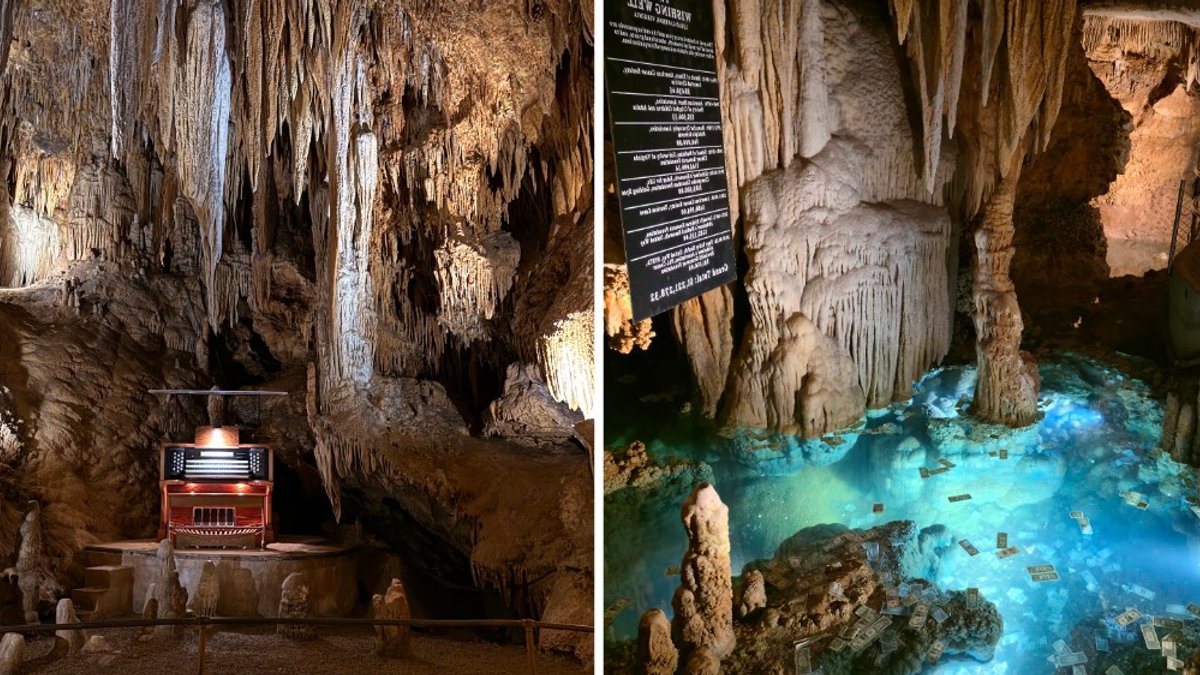
Deep inside Luray Caverns in Virginia, visitors do not merely walk through a cave—they experience its sound. Since 1957, the cavern’s ceiling has hosted the Great Stalacpipe Organ, a unique musical system that transforms natural stalactites into musical notes by striking them with rubber-tipped plungers. Unlike conventional organs, which depend on pipes or strings, this instrument uses the cave itself as its resonance chamber, with each selected stalactite producing a distinct pitch when tapped.
The organ’s creation began with a moment of observation in 1954. Leland W. Sprinkle, a mathematician and electronics scientist then employed at the Pentagon, visited the caverns and noticed what others had overlooked: when a guide struck a stalactite with a mallet, it emitted a clear, bell-like tone. Sprinkle, who lacked formal musical training, recognized the potential in this discovery. Over the following three years, he tested formations throughout the cavern using thirteen English tuning forks to identify stalactites capable of producing stable, distinct notes.
Read Also: Northern Georgia Cascades Draw Hikers to Scenic Waterfalls
By 1957, Sprinkle had developed a fully functional instrument. The organ’s console resembles a traditional keyboard, but instead of pipes or strings, it controls electrical mechanisms positioned near specific stalactites. When a key is pressed, or when an automated sequence triggers, rubber mallets strike the formations, producing notes that reverberate through the cavern’s vast chambers. The result is music that appears to emerge directly from the rock itself.
How the cave’s acoustics shape the music
The instrument’s design reflects Sprinkle’s precise methodology. He selected stalactites from an area spanning over three acres, ensuring each could generate a specific pitch. The mechanisms remain hidden, but their placement follows the cave’s natural layout. Some notes originate near the organ’s chamber, while others come from formations farther along the tour route. This distribution creates an immersive auditory experience, as the music seems to move through the space rather than originate from a single source.
Automated performances play during regular cavern tours, allowing visitors to hear the organ without requiring a separate concert. Manual performances, however, remain exclusive to special occasions. The system’s precision ensures that the rubber-tipped mallets deliver a controlled strike, preserving the delicate formations while producing clear, resonant tones. Some notes fade quickly, while others linger against the cavern’s walls, blending into harmonies that feel both organic and meticulously crafted.
Read Also: Utah Store Delights Model Train Enthusiasts
Science, art, and a 20th-century marvel
For Sprinkle, the project represented more than a scientific curiosity; it was an intersection of art and engineering. The work demanded years of testing, adjustments, and patience, as each stalactite had to meet exacting standards. The final result is an instrument that feels simultaneously ancient and modern: the rock formations date back millions of years, while the electrical controls and automated systems reflect mid-20th-century technology. Today, the organ remains one of the few places where a cave’s natural features serve as a musical instrument.
The tour’s self-guided format allows visitors to pause at points of interest, though the cavern’s steady temperature and high humidity suggest packing a light jacket regardless of the season. The paved walkways, illuminated to highlight the formations, replace the candles and lanterns used by early explorers like Andrew Campbell and his nephew Quint in 1878. Their discovery of the cavern on August 13, 1878 marked the beginning of its recorded history, though the spaces beneath the Page County field had likely been forming for millennia. The modern tour preserves elements of this history, from the original wooden paths to its designation as a National Natural Landmark in 1974, while adding the organ’s mechanical notes to the cave’s natural soundtrack.


