
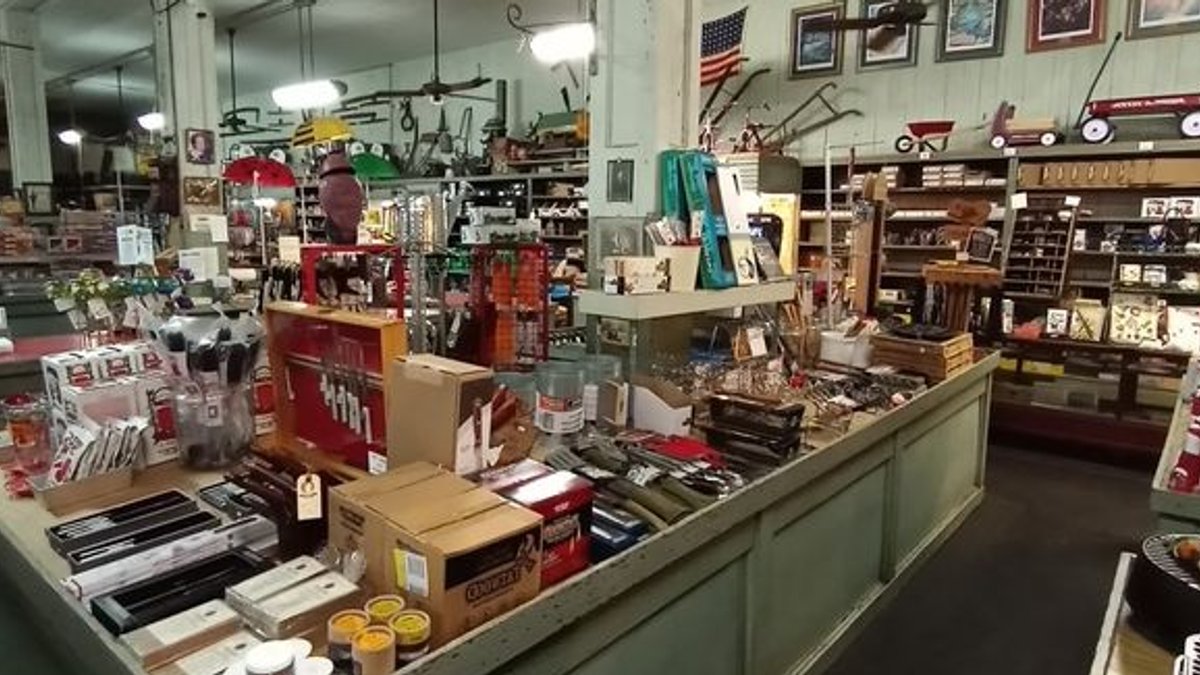
Since 1863, the Kaffie-Frederick General Mercantile on Front Street in Natchitoches has served customers with everything from hardware supplies to Radio Flyer wagons—all processed through a 100-year-old cash register still in active use.
Half of it still operates as a real hardware store, while the other half features classic toys, gifts, and kitchen goods. This shop retains a long memory and remains very much open for business.
A Store With A Long Memory
Front Street in Natchitoches runs along the Cane River, lined with ironwork balconies and old brick storefronts. At number 758 sits Kaffie-Frederick General Mercantile, a business selling goods to this town since 1863.
Maps label it simply as a hardware store, which is accurate. Roughly half the floor space holds tools, plumbing parts, cast iron, and small repair items essential for maintaining a house.
One visitor aptly noted that you can buy PVC pipe in one area and pickle grabbers in another, with perfume, jewelry, kids’ toys, and saws all under the same roof.
Read Also: Thanksgiving airfares hit lowest point now
From Prussia to Louisiana: The Kaffie Brothers’ Journey
A store operating for over 160 years on its main street fits such a town.
Two Brothers, A Peddler’s Pack And A Wartime Start
Long before the building existed, there was a pack on someone’s back.
They began as many merchants of that era did, going door to door. Their customers were often plantation households, and their goods were practical: needles, linens, and dry goods hard to find in the countryside.
Selling in person meant understanding families’ exact needs, a habit shaping the store for generations. Opening a business then required courage, as supply lines were unreliable and money was scarce across the South.
Despite this, the enterprise succeeded, and the peddling route gave way to a fixed address in town. This beginning remains relevant today.
A Historic Building, A Living Museum
The Kaffie brothers constructed the current Front Street building in 1892, nearly three decades after starting the business. It is listed on the National Register of Historic Places, retaining much of its original appearance and fixtures.
Read Also: Cheaper flights fuel surge in Eastern Europe travel demand
Wooden floors, tall shelving, and an upper level give the space the feel of a working warehouse rather than a modern retail store. Visitors often note that the store explains its history as you explore.
Aisles are narrower than in chain stores, displays are stacked higher, and the second floor feels like a separate discovery once you find the stairs. Some shoppers only realize there’s an upstairs when a clerk mentions it, making it worth asking upon arrival.
The Frederick Family Joins the Legacy
Every long-running family store eventually needs another family, and here that family arrived in 1920. Titus Frederick joined the business that year, and his name eventually shared the sign with the Kaffies.
It operated through both World Wars and the Great Depression, adapting its inventory as the parish’s needs changed. In the early 1900s, shelves and floor space held harrows, John Deere plows, and fabric for clothing, reflecting its role as a supplier for farm families.
Today, the grandchildren of Titus Frederick run the mercantile. Visitors note that the owner often greets people on the floor, a rarity in regional chains.
Read Also: WTTC urges calm over Africa Ebola travel fears
Family operation explains much about the store’s character. Decisions about inventory, additions, and customer treatment come from those personally invested in the building’s next hundred years, not a distant corporate office.
Antique Machinery Still in Daily Use
Many old stores display antique registers as decorations. Kaffie-Frederick actually uses theirs.
Shoppers often highlight it as a memorable detail, with one visitor encouraging others to look for the register over 100 years old and still in use.
Historic Artifacts Reflect the Store’s Agricultural Past
A vintage cotton bale scale inside the store serves as a reminder of Kaffie-Frederick’s role as a major cotton broker from the 1880s to the mid-20th century. This scale, once central to the region’s farm economy, weighed crops and connected growers to buyers, representing a significant part of the store’s early function.
Another working relic is the freight elevator, installed in the 1890s, originally operated without electricity and later converted to electric power. It continues to move goods between floors, preserving the building’s original method of handling heavy inventory in daily operations.


